Piano Ballz Beat: Music Games
- 4.2
- Rating
- 1.00M
- Installs
- Free
- Price
 Analysis by App-foxy
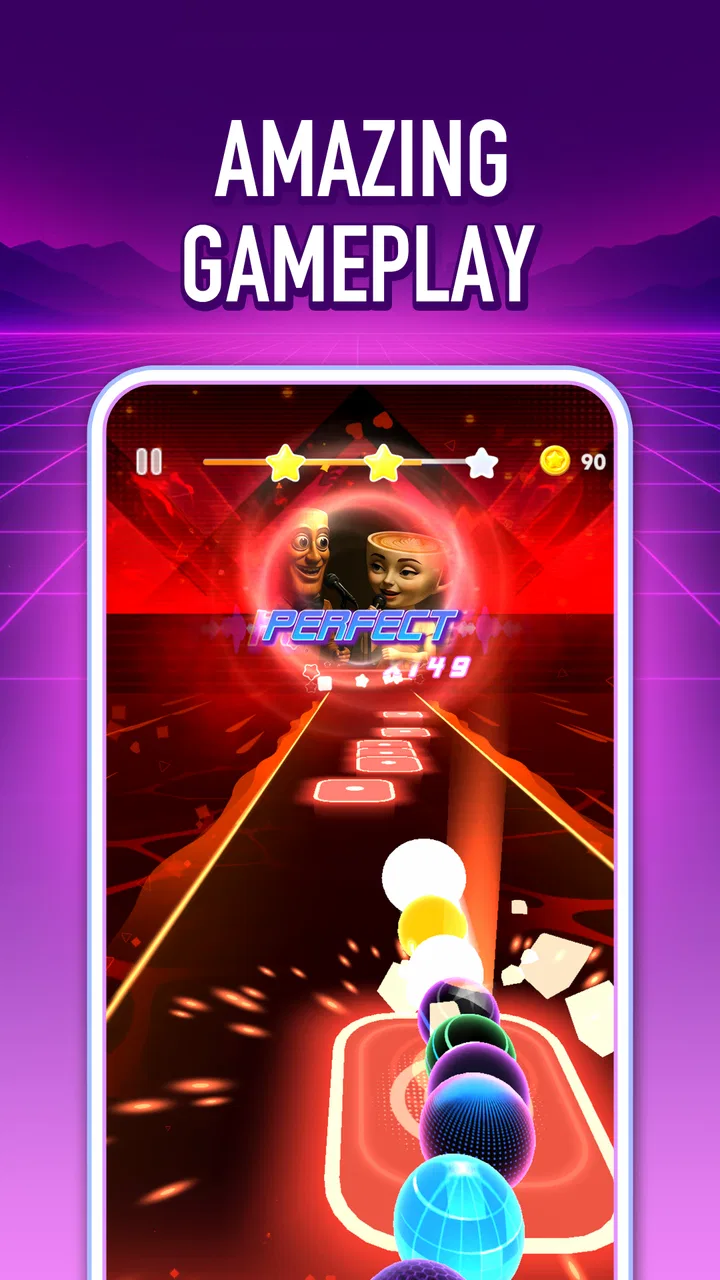
I spent time with Piano Ballz Beat: Music Games as a light music game rather than treating it like a serious piano-learning tool. That distinction matters immediately. The appeal is the combination of familiar piano-game timing and a bouncing-ball presentation, with a focus on popular K-pop songs. It is made for quick sessions, easy entry, and the satisfying feeling of keeping a rhythm going when the screen starts moving faster.
My first impression was that this is the kind of game I would open when I have a few spare minutes, not something I would plan an evening around. The concept is simple enough to understand without a tutorial-heavy introduction: follow the musical flow, react to what appears, and try to stay in control. That simplicity is a strength for casual players, although it also means people looking for a deep rhythm-game system may want more complexity than this title is designed to offer.
How the current version feels to play
The game sits in the music category and is developed by Cobby Labs. Its identity comes from putting piano-style play together with ball-game movement, so the experience is less about pressing keys freely and more about responding to a visual path that follows the song. I found that combination easy to understand but still demanding enough to make a short attempt feel active.
You May Also Like

 Blood Strike: 2.5 Anniversary
Blood Strike’s Loadouts Turn Every Drop Into a Tactical Gamble
A close look at Blood Strike’s custom loadouts: how fast access to signature weapons reshapes its battle royale rhythm, rewards preparation, and narrows the gap between fights.

 Pandora - Music & Podcasts
Pandora’s Music Is Easy to Start, but Harder to Recover
Pandora’s strength is its low-effort path from a seed to a station. Its weak spot is how much confidence it asks you to place in connection, setup, and quiet recovery.

 8 Ball Pool
 Is Built on Rivalries, Rematches, and Routine
A close look at the rivalries, rematches, shared routines, and unanswered safety questions that turn a quick pool match into a persistent mobile community.

 Samsung Music
’s Quiet Strength Is Playing What You Already Own
Its reach comes less from spectacle than from dependable access to a personal library. That simplicity is both the app’s strongest retention engine and its ceiling.

 AccuWeather: Weather Radar
AccuWeather Review: A Quick, Clear Forecast for Everyday Decisions
For everyday plans, the best forecast is the one you can understand quickly. AccuWeather makes rain timing, radar, and local conditions easy to act on, with a few trade-offs.

 Hill Climb Racing
Why Hill Climb Racing Still Turns Crashes Into One More Run
A tiny car, a bumpy hill and one more upgrade: Hill Climb Racing keeps resurfacing because its simple chaos makes every near-miss feel personal.
More From Our News Desk
View All News


The best way to approach it is with a relaxed mindset. At first, I was tempted to watch the ball and the next visual cue at the same time, but that made my reactions late. I had better results when I treated the upcoming pattern as the important information and used the current movement mainly to maintain a sense of timing. That small change is one of the practical lessons the game teaches quickly: looking only at the most obvious object is not always enough.
It works particularly well in short bursts. I can imagine playing while waiting for a friend, taking a break between tasks, or winding down without wanting to learn a complicated control scheme. The free price also makes it easy to try without turning the decision into a purchase commitment. Since the content rating is Everyone, it is positioned as an accessible choice for a broad audience, including younger players who enjoy music-based tapping and reaction games.
That accessibility does not mean every session is effortless. Rhythm games depend heavily on concentration, and the ball-focused presentation can become visually busy once the pace increases. If your timing is slightly behind the beat, a sequence that looked simple can fall apart quickly. I enjoyed that tension, but I also noticed that repeated misses can feel more frustrating than motivating if I keep replaying the same section without changing my approach.
The K-pop focus gives the game its personality
The K-pop angle is more than a label attached to a generic piano format. It gives the game a clear reason to exist alongside the many other music-tapping options on mobile. Players who already enjoy the style may be more willing to explore the song selection and replay familiar tracks. For someone who does not follow K-pop, the music can still work as a lively rhythm backdrop, but the theme may not provide the same immediate connection.
I would not choose this game as a substitute for a full music library or a dedicated rhythm-game platform. Its attraction is the compact combination of recognizable pop energy, bouncing visual motion, and quick reactions. That makes it a better fit for casual entertainment than for people who want extensive song customization, instrument practice, or a highly technical competitive system.
One useful habit is to play with sound at a comfortable level rather than relying on visuals alone. The audio helps establish the rhythm, while the screen tells me what action is coming next. When I mute the game, it becomes more like a visual reflex test, and I lose part of what makes the music category meaningful. Headphones can help in a noisy room, but I would still keep the volume moderate during longer sessions.
What the release and version tell me
The game was released on January 12, 2026, and the current version is 0.2.1. I read that version number as a sign that the product is still at an early stage of its life rather than as proof of a fully settled, feature-rich platform. The core idea is already clear, but early versions can change noticeably as the developer adjusts the experience, adds content, or responds to player reactions.
That early status affects how I judge it. I am more forgiving of a compact feature set when the central loop is understandable and enjoyable, but I also avoid assuming that every future improvement is guaranteed. The current build should be judged on what it offers now: a free K-pop piano game with ball-based movement, quick sessions, and an accessible starting point.
The minimum operating requirement is Android 6.0, which gives the game a broad compatibility range for Android users. That is helpful if you are using an older device, although compatibility on paper does not automatically mean identical performance on every phone. Rhythm games are especially sensitive to delays, so a device that handles ordinary apps comfortably may still feel less responsive if the display or audio timing is not ideal.
Before blaming yourself for missed notes, I would test the game in the exact environment where you plan to play. Try a quiet room, close unnecessary background activity, and check whether your touch response feels consistent. This is not a glamorous tip, but it can separate a genuine timing mistake from a device or environment problem. In a rhythm game, that difference changes the entire experience.
How existing players may experience the current build
For someone discovering the game now, the low barrier to entry is probably the biggest advantage. I do not need to understand a complicated progression system before enjoying a song. I can start with the basic idea, learn the visual rhythm, and decide quickly whether the ball movement feels satisfying. That makes it suitable for sharing with a friend who normally avoids games with dense menus or complex controls.
Players who have already tried similar piano games may have a more mixed reaction. The familiar timing structure means the first few minutes can feel immediately comfortable, but familiarity also makes differences more important. Here, the ball presentation is the main change in feel. It adds motion and gives the playfield a more animated character, yet it may not be enough for someone who wants a radically different rhythm system.
I also think returning players should resist judging progress only by whether a song is completed. A better personal measure is whether I can anticipate the next movement earlier, keep a longer uninterrupted sequence, or recover calmly after one mistake. That mindset makes the game less dependent on unlocking a dramatic reward and more focused on improving reaction and musical awareness.
The audience size suggests that the game has already attracted meaningful attention: it has passed 500K+ installs and holds a 4.4 average from 427 ratings. Those figures make it easier for me to see the title as an active casual-game choice rather than an obscure experiment, but they do not replace personal testing. A popular rhythm game can still be a poor fit if its songs, visual style, or pace do not match your preferences.
There are also 5 reviews shown alongside those ratings, so I would place more weight on the overall rating signal than on a small written-review sample. For a prospective player, the practical takeaway is simple: the game appears to have broad enough interest to merit a try, but the best evidence for you will be whether the controls feel responsive on your own phone.
Small techniques that make the game easier to read
My most useful adjustment was to stop chasing the ball with my eyes at the last possible moment. Instead, I watched the next part of the route and prepared my finger position before the action arrived. This reduced rushed taps and made faster passages feel less random. It is a transferable rhythm-game habit, but the bouncing presentation makes it especially valuable here because the movement can draw attention away from what is about to happen.
A second tip is to use short practice cycles instead of repeating a failed run immediately. After a miss, I pause mentally, identify whether I reacted late or followed the wrong visual cue, and then restart with one specific correction. Repeating without diagnosing the mistake usually produces the same result. This approach is more effective for players who want to improve without turning a free casual game into a source of unnecessary stress.
A third useful scenario is playing in two different modes depending on your goal. If I want relaxation, I focus on the song and accept occasional misses. If I want a challenge, I treat each run as a timing exercise and remove distractions from the room. The game supports both attitudes because its basic interaction is simple, but the quality of the session depends on whether I choose entertainment or improvement before starting.
Screen position matters too. Holding the phone in a stable way can make a surprising difference when a sequence demands quick reactions. I prefer a grip that leaves my tapping finger free without covering the area where the next movement appears. If I am playing while walking, commuting, or multitasking, my performance drops—not necessarily because the game is harder, but because my attention is divided. This is a title that rewards giving it a few focused minutes.
Where it still feels limited
The biggest limitation is the narrowness of the core idea. Piano tapping with a ball-game presentation is approachable, but players who expect multiple play styles, detailed customization, or a large competitive layer may find the experience modest. I would not recommend it to someone choosing a music game primarily for long-term depth or for structured musical education.
It is also not the right pick if your main goal is learning to play piano. The game may improve reaction, timing, and familiarity with musical phrasing, but those benefits are not the same as learning hand position, scales, reading notation, or performing on a real keyboard. A piano-learning app would be the better choice for those needs, while a more advanced rhythm game would suit players seeking technical challenge and richer systems.
The visual movement can be another dividing line. Some players will enjoy seeing the ball travel through the song because it makes each run feel lively. Others may find that the animation competes with the timing cues, particularly during quick sections. I would give it several attempts before deciding, because the eyes can adapt, but I would not dismiss that concern if you already struggle with visually dense rhythm games.
Song preference is equally important. The K-pop focus is a clear advantage for fans, but it narrows the emotional range compared with broader music games. If you want rock, classical, electronic, or a personal library, this may feel restrictive. Choosing a game based on its music is reasonable here because the songs are not just background decoration; they determine much of the motivation to replay.
As an early version, 0.2.1 also makes the product feel like a work in progress. That can be exciting for players who enjoy watching a small game develop, but less appealing for anyone who wants a mature experience with every system already polished. I would keep expectations grounded and evaluate updates by their actual effect on play rather than assuming that a low version number promises a particular roadmap.
What I would watch before committing to regular play
If I were deciding whether to keep the game installed, I would watch how consistently the controls respond across different sessions. In a rhythm title, reliable timing matters more than decorative extras. I would also pay attention to whether new content keeps the K-pop focus interesting or whether the available selection begins to feel repetitive after the novelty fades.
I would watch the balance between challenge and accessibility as well. A good casual rhythm game should let a new player understand the basics while still giving experienced players a reason to improve. If the early sections are too easy and later sections become abrupt rather than demanding, the learning curve may feel uneven. My preference is for difficulty to teach me something about reading the route, not simply punish a slower reaction.
The developer to watch is Cobby Labs, particularly in how it shapes the game after this early release period. Meaningful progress would be visible in smoother play, clearer feedback, thoughtful song expansion, or improvements that make repeated sessions more rewarding. I would judge those changes by whether they solve real friction rather than by the size of a version number.
For now, the game is easy to recommend to a specific person: someone who likes K-pop, wants a free music game that can be understood quickly, and enjoys testing reaction speed through animated piano-style play. I would suggest trying it on a stable device with audio enabled and giving the visual rhythm a little time to become familiar.
I would skip it if you need a piano tutor, a broad music catalog, or a deep competitive rhythm platform. Those expectations point toward different kinds of apps. But if your ideal session is a few minutes of focused tapping, musical momentum, and ball-based movement without a complicated setup, this is a pleasant option to explore.
My final view is that Piano Ballz Beat: Music Games has a clear, approachable identity and enough personality to stand apart from a completely plain piano tapper. Its strongest qualities are the quick learning curve, the K-pop direction, and the way its moving presentation turns familiar timing into a more active visual challenge. Its limitations come from the same simplicity: the experience may not yet satisfy players who want extensive depth or a mature collection of systems.
At no cost and with an Everyone rating, it is an easy low-risk download for curious casual players. I would treat it as an early, focused music game rather than a complete rhythm ecosystem. If Cobby Labs continues refining the timing, variety, and long-term reasons to return, the concept has room to become more compelling. In its current form, I enjoyed it most as a short, energetic break where the goal is not to master a piano, but to stay with the beat and keep the ball moving.
FAQs for Piano Ballz Beat: Music Games
01What is Piano Ballz Beat: Music Games?
Piano Ballz Beat: Music Games is an engaging rhythm-based game where players tap along to catchy tunes using vibrant, bouncing balls. The game combines music with dynamic visuals to create an immersive experience, challenging players to match the rhythm accurately and advance through increasingly difficult levels.
02Which platforms support Piano Ballz Beat: Music Games?
Piano Ballz Beat: Music Games is available for both Android and iOS devices. You can download it from the Google Play Store for Android or the Apple App Store for iOS. Make sure your device meets the minimum system requirements to ensure optimal performance.
03Does Piano Ballz Beat: Music Games require an internet connection?
Piano Ballz Beat: Music Games can be played offline, making it perfect for on-the-go entertainment without worrying about internet connectivity. However, an internet connection might be needed for downloading updates, accessing additional content, or participating in online leaderboards.
04Are there in-app purchases in Piano Ballz Beat: Music Games?
Yes, Piano Ballz Beat: Music Games offers in-app purchases. Players can buy additional features, such as new songs, themes, or power-ups. While the game is free to download and play, these purchases enhance the gaming experience but are not necessary to enjoy the core gameplay.
05Is Piano Ballz Beat: Music Games suitable for all ages?
Piano Ballz Beat: Music Games is designed for players of all ages, offering a family-friendly gaming experience. Its intuitive controls and entertaining music make it appealing to both children and adults. Parental guidance is recommended for in-app purchase management, especially for younger players.
Pros
- Engaging rhythm gameplay.
- Wide variety of music tracks.
- Intuitive controls for all ages.
- Visually appealing graphics.
- Regular updates with new features.
Cons
- Contains in-app purchases.
- Ads may interrupt gameplay.
- Requires internet for full features.
- Limited offline play options.
- High battery consumption.

Piano Ballz Beat: Music Games
Gallery